America’s transportation system faces a hard mix of ageing infrastructure, aviation safety concerns, rising travel demand and pressure to deliver major projects without needless delay. The Federal Aviation Administration (FAA) alone guides more than 50,000 flights a day, according to the Government Accountability Office (GAO). Running the department responsible for all of this takes more than political experience. It takes an understanding of how large institutions work, how public money is allocated and how every decision lands on the millions of people who depend on reliable transport each day.
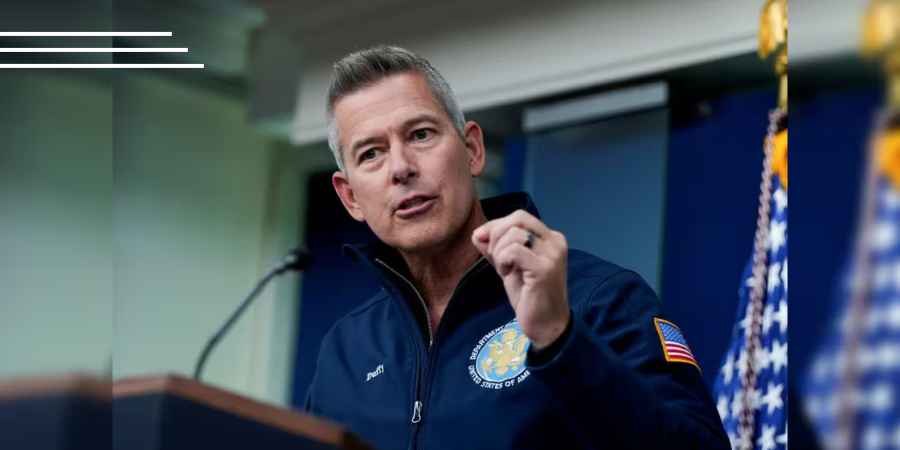
As the 20th US Secretary of Transportation, Sean Duffy brings an unusual background to the job. His career has run through law, congressional politics and television broadcasting, and only then to the Department of Transportation (DOT). That mix has shaped his public profile. The real measure of his effectiveness, though, will be whether announced priorities turn into safer journeys, more dependable infrastructure and finished projects.
His approach is most visible in the FAA’s modernisation programme. The department is trying to fix problems that built up over decades, from replacing outdated communications equipment to restructuring aviation oversight.
The more interesting question is how Duffy handles these responsibilities: which experience informs his decisions, how he responds when transportation systems come under strain, and whether his administration can balance rapid execution with public safety.
Leadership transition: From law and Congress to transportation
Sean Duffy’s career looks nothing like that of a conventional transportation administrator. He was born and raised in Hayward, Wisconsin, and studied marketing before earning a law degree from William Mitchell College of Law in 1999. He then worked as a prosecutor and became district attorney of Ashland County in 2002, a post he held until 2010.
That legal career gave him practice in weighing evidence, answering to the public and making decisions under scrutiny. Prosecutors must compare competing accounts, establish facts and make calls that carry serious consequences.
Politics brought a different set of responsibilities.
Voters elected Duffy to the US House of Representatives in 2010, and he represented Wisconsin’s Seventh Congressional District from January 2011 to September 2019, across five terms. He served on the House Financial Services Committee and co-chaired the Great Lakes Task Force, which gave him exposure to economic policy and regional transportation concerns. He also sponsored the Puerto Rico Oversight, Management, and Economic Stability Act, known as PROMESA, which addressed the island’s debt crisis and the continuity of public services.
After leaving Congress in 2019, Duffy moved into broadcasting and later co-hosted Fox Business Network’s The Bottom Line from 2023.
In January 2025, he became the 20th US Secretary of Transportation.
This path gives him three distinct kinds of experience that bear on the current role:
- Legal experience: Understanding investigations, evidence, compliance and institutional accountability.
- Congressional experience: Working with legislation, public funding and competing regional priorities.
- Broadcasting experience: Explaining complicated developments to a broad audience and responding to public scrutiny.
Experience from outside a technical industry can bring valuable perspective, but it does not replace specialist knowledge. A transportation secretary depends on engineers, safety investigators, air traffic controllers, infrastructure planners and agency administrators to turn policy decisions into operational improvements.
My observation is that the real test of Duffy’s transition is not how quickly he learned the department’s responsibilities. It is how well he builds the expertise and accountability structures needed to manage them.
Crisis management: Aviation safety and the pressure to modernise
Aviation has become one of the most demanding parts of Sean Duffy’s transportation agenda. The United States runs an enormous airspace system, and its reliability rests on communications networks, radar equipment, control facilities, software and a highly trained workforce.
Some of these systems have run for decades. In its 2024 report, the GAO said the FAA had assessed 51 of its 138 air traffic control systems (37 percent) as unsustainable, with another 54 (39 percent) rated potentially unsustainable. The reasons included outdated functionality and trouble obtaining spare parts. The GAO also warned that the agency had been slow to modernise the most critical and at-risk systems. That assessment followed a 2023 shutdown of the national airspace caused by the outage of an ageing system, so the risk is far from theoretical.
For Sean Duffy, this creates a hard management problem. Modernisation cannot wait indefinitely, yet upgrading critical aviation infrastructure while daily operations continue demands careful sequencing.
The department has pursued several initiatives:
- Air traffic control investment: Congress provided $12.5 billion for modernisation through legislation passed in 2025.
- Communications upgrades: The FAA has been replacing older telecommunications connections and upgrading radio systems.
- Runway awareness: Surface surveillance technology helps controllers monitor aircraft and vehicles moving around airport runways.
- Organisational restructuring: In January 2026, Duffy and FAA Administrator Bryan Bedford announced a major FAA reorganisation, including a centralised safety management structure and dedicated offices for airspace modernisation and advanced aviation technologies.
The September 2026 deployment of the 100th Surface Awareness Initiative system marked another milestone. The FAA said the installation reached nearly half of the 220 airports set to receive the tool, with 44 more planned before the end of 2026. The technology gives controllers a real-time view of aircraft and vehicles on airport surfaces, including in conditions where the tower’s own view may be limited.
Together, these steps show an effort to move from broad infrastructure commitments towards specific operational improvements.
The scale of the challenge became especially clear in November 2026. On November 13, a telecommunications failure affecting communications and radar systems used by air traffic control led the FAA to issue a nationwide ground stop, which lasted a little over four hours. The FAA reported roughly 12,462 flight cancellations in the aftermath, including 9,082 by major airlines. The administration then formally asked Congress for $50.1 billion for further aviation and air traffic control modernisation, on top of the $12.5 billion already provided in July 2025. An earlier request had been about $30 billion. Of the new total, $10.1 billion would go to air traffic control modernisation. Duffy said the existing funds were already committed to specific upgrades and did not cover a new telecommunications network.
The FAA and network provider L3Harris are investigating whether router equipment or installation errors triggered the outage, and the FAA paused new router installations while that work continues.
This incident shows the difference between installing new equipment and modernising an entire network. A transportation system can receive large investment and still suffer disruption if critical components stay outdated, or if new infrastructure cannot communicate reliably with the old.
For anyone studying crisis leadership, the point is clear. Responding to an infrastructure failure means more than restoring normal operations. It also means establishing why the failure happened, finding weaknesses elsewhere in the network and making sure corrective action can be verified independently.
Sean Duffy’s November response included calls for more funding and an investigation into the telecommunications failure. The final assessment will depend on what that investigation finds and on how well the corrective measures work.
Strategic execution: Balancing investment, safety and accountability
Infrastructure modernisation is not just a matter of approving budgets. It means deciding which projects deserve priority, coordinating several agencies, managing contractors and making sure public money produces measurable improvements.
This is where Duffy’s approach to transportation policy faces its biggest test. The Department of Transportation oversees a vast network of roads, bridges, railways, airports and other essential systems, and each has its own technical requirements, funding arrangements and timelines.
The department’s priorities under Duffy include infrastructure investment, operational efficiency, transportation safety and faster project delivery. Its August 2026 announcement of $870 million in airport infrastructure improvements shows how those priorities become funding decisions. The money came through 339 grants across 44 states and two territories, and it was the final instalment of the $14.5 billion Airport Infrastructure Grants programme created by the 2021 infrastructure law. The largest single award, $289 million, went to Los Angeles International Airport for a new terminal access road. Other projects include terminal improvements and runway reconstruction at smaller airports, such as $3.5 million for Sugar Land Regional Airport in Texas.
Three considerations stand out in this approach:
1. Turning funding into completed projects
Funding announcements attract attention, but their value depends on delivery. Transportation projects often involve planning approvals, environmental reviews, procurement, engineering assessments and coordination between federal, state and local authorities.
An effective infrastructure approach therefore needs clear responsibilities, realistic timelines and open progress reporting.
2. Making safety part of operational decisions
Aviation safety, road safety and infrastructure reliability cannot be treated as separate goals. Modern equipment can improve operations, but only alongside proper maintenance, workforce training and effective oversight.
For Duffy, the challenge is to make sure faster project delivery does not weaken safety procedures or lower the quality of technical assessments.
3. Improving organisational accountability
Large government departments can struggle when responsibilities are scattered across agencies. The FAA’s restructuring is an attempt to improve coordination by placing safety management and modernisation in more clearly defined structures.
My observation is that transportation leadership should be judged by outcomes rather than announcements. A new airport facility, an upgraded control system or a rebuilt road matters because of the difference it makes to daily operations. Measuring that difference requires open reporting on delivery dates, costs, reliability and safety performance.
For this reason, transportation infrastructure leadership combines strategic decision-making with the less visible work of monitoring implementation.
What can business leaders learn from this approach?
A government department faces different challenges from a private company, but several management principles apply in both settings.
- Understand the existing system before changing it: Large organisations often carry legacy processes that cannot be replaced overnight.
- Prioritise operational risks: Investment decisions should weigh the consequences of failure, not just how visible a project is.
- Give technical teams a meaningful role: Senior leaders need specialist advice when decisions involve complex systems.
- Connect spending with measurable outcomes: Budgets should link to clearly defined performance goals.
- Communicate during difficult periods: Stakeholders need accurate information when disruptions or project delays occur.
These principles also explain why Sean Duffy’s leadership is worth examining beyond his political position. The role involves coordinating people, budgets, technical expertise and public expectations inside an organisation whose performance directly affects the wider economy.
Conclusion
The next phase of Sean Duffy’s tenure will depend heavily on whether transportation modernisation programmes deliver lasting improvements.
Aviation will remain an important test case, particularly as the government seeks additional funding after the November disruption. Replacing outdated technology is necessary, but the department must also show that the new systems work reliably together and that the FAA has the workforce and organisational capacity to maintain them.
Other transportation priorities will need similar attention. Roads and bridges require sustained maintenance, airports must handle changing passenger demand, and emerging technologies such as drones and advanced air mobility will need appropriate regulatory oversight.
The broader challenge is keeping a balance between innovation and institutional responsibility.
People often link crisis leadership with quick decisions in emergencies. Public sector leadership asks for something more demanding: building systems that prevent foreseeable failures, respond well when problems occur and learn from the experience.
Duffy’s varied career gives him an interesting foundation for this responsibility. His experience in law, Congress and broadcasting brings different perspectives to a department that depends on technical expertise and operational discipline.
In the end, Sean Duffy will be judged less by the scale of his announcements than by the reliability of the transportation systems under his department’s oversight. His ability to turn political priorities into practical improvements will determine how successful his approach proves to be.
For business leaders, the broader lesson is simple: large-scale change takes more than a compelling vision. It needs informed decisions, capable teams, clear accountability and the patience to see complex projects through to completion.