Technology companies fight over talent. Pay, benefits, interesting products and a clear path upward all help them win people. Winning is the easy half, though. Keeping those people is harder. It takes trust, and it takes a workplace where employees feel their work counts.
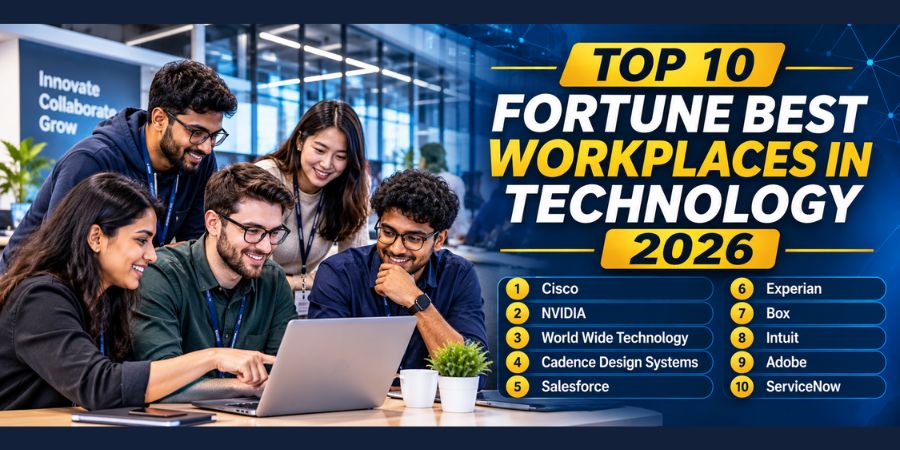
Great Place To Work built the Fortune Best Workplaces in Technology™ 2026 rankings from employee surveys, so the list says a good deal about what people in this sector want from an employer. Cisco finished first among large technology companies. NVIDIA took second and World Wide Technology third, with Cadence and Salesforce filling out the top five.
Timing adds weight to this year’s list. AI is changing job roles, daily workflows and what businesses expect from their staff, and employees are watching closely to see how their employers handle it.
Anyone looking for the best technology companies to work for can use the rankings as more than a shortlist of names. They show how leaders behave, how these organisations run day to day and what employees say about both.
How Were the Best Workplaces in Technology 2026 Selected?
The rankings come straight from employee feedback. Great Place To Work runs the Trust Index survey, which asks people how they experience leadership, fairness, respect, credibility, collaboration and pride in their employer. Fortune reports that the 2026 technology list reflects survey feedback representing nearly 144,000 U.S. employees. Company rankings on the industry lists come from 60 questions in the survey.
The related 2026 Fortune 100 Best Companies to Work For programme went wider. It drew on more than 1.3 million confidential responses, nearly 640,000 of them from employees at eligible companies, and the survey pool covered more than 7.3 million U.S. workers.
The survey covers a range of topics, including:
- Whether leaders communicate honestly and make themselves easy to reach.
- Whether employees feel respected and appreciated.
- Whether people get a fair shot at development and promotion.
- Whether employees trust the decisions management makes.
- Whether people feel connected to their teams and to the organisation’s purpose.
- Whether employees can share ideas and see their work make a difference.
The ranking also checks for consistency. A good score needs positive experiences to reach the whole workforce, across demographic groups and job roles, and not only a happy majority. Company programmes and written answers add background, but the employee survey results alone set list placement.
That is why the methodology deserves attention. A company can list impressive benefits and still have employees who feel ignored.
Top 10 Fortune Best Workplaces in Technology, 2026
The following are the top 10 large technology organisations in the 2026 ranking.
01.Cisco
San Jose, California
Leadership accessibility and employee development
02. NVIDIA
Santa Clara, California
Purpose, innovation and employee well-being
03. World Wide Technology
St. Louis, Missouri
Belonging and approachable leadership
04. Cadence Design Systems
San Jose, California
Engineering collaboration and technical growth
05. Salesforce
San Francisco, California
Learning, flexibility and purpose
06. Experian
Costa Mesa, California
Data-driven innovation and employee experience
07. Box
Redwood City, California
Collaboration and workplace flexibility
08. Intuit
Mountain View, California
Learning, customer focus and innovation
09. Adobe
San Jose, California
Creativity and professional development
10. ServiceNow
Santa Clara, California
Technology-led transformation and collaboration
1. Cisco: Making employee development part of business strategy
Rank 1
Cisco took first place with a culture built around collaboration, accessible leaders and professional growth. It also placed No. 3 on the 2026 Fortune 100 Best Companies to Work For, so it holds its own against employers in every industry.
Employee feedback mentions managers who back their teams, recognition for individual and group wins, space to learn from mistakes and chances to give back to the community.
The 2026 annual report fills in the detail. Cisco describes personalised learning, leadership programmes at every level and skills intelligence that matches people to career openings. Company-wide meetings, leadership check-ins and confidential surveys give employees regular ways to speak up and hear back.
Observation for business leaders: Development only counts when it leads somewhere. A training course may sharpen a skill, but employees also need a chance to use it, try a different role and get honest feedback from their manager. Cisco treats learning as part of ordinary management, not a separate perk.
2. NVIDIA: Connecting employees to a shared mission
Rank 2
NVIDIA sits at the centre of accelerated computing and AI, and its employees know it. Feedback shows confidence in leadership, pride in the technology and a feeling of being supported and rewarded. The company also placed No. 6 on the 2026 Fortune 100 Best Companies to Work For, and it is the only “Magnificent Seven” member on that list.
A shared mission matters more in fast-moving markets. When employees understand the purpose behind a project, the work feels tied to something larger than their own task list.
Observation for business leaders: A mission statement does nothing until it shapes daily decisions. Employees should know how their job feeds the company’s direction, and they need room to suggest ideas. People believe in a mission when they can point to their own fingerprints on the result.
3. World Wide Technology: Building belonging through approachable leadership
Rank 3
World Wide Technology (WWT) puts a lot of weight on relationships, collaboration and belonging. Employee comments describe a close-knit workplace where colleagues help each other and senior leaders come across as humble, approachable and in touch with people at every level. WWT also ranked No. 10 on the 2026 Fortune 100 Best Companies to Work For and No. 3 in the large category of the UK’s 2026 Best Workplaces, so its culture clearly works outside the United States too.
Technology businesses depend on technical and business teams working together, which makes this kind of culture especially useful for them.
Observation for business leaders: Belonging comes from repeated, ordinary interactions, not from an occasional team-building day. Managers who listen, stay reachable and notice good work help people feel part of the organisation. In a large company, where employees can easily feel far from the people making decisions, that counts for a lot.
4. Cadence Design Systems: Supporting collaboration in complex engineering
Rank 4
Cadence Design Systems makes computational software for semiconductor design and system innovation. Its fourth-place finish puts an engineering-driven company among the best technology workplaces.
Complex technical work relies on deep specialist knowledge, problem-solving across teams and constant learning. The culture has to let engineers swap ideas freely while protecting the concentration that hard projects demand.
Observation for business leaders: Specialists should be able to grow without becoming managers. Technical career tracks, mentoring and difficult projects keep experienced engineers who would rather deepen their craft than supervise others.
5. Salesforce: Encouraging learning and career exploration
Rank 5
Salesforce blends enterprise technology, customer-focused innovation and employee development. Employees point to chances to learn new skills, try different parts of the business and join community projects.
Moving between roles has become more useful as AI and cloud tools change what companies need. Plenty of employees will switch functions or build entirely new expertise at some point in their careers.
Observation for business leaders: People stay when they can see a future where they already work. Internal moves, easy access to learning and supportive managers make promotion more realistic than filling every senior role from outside.
6. Experian: Connecting data expertise with innovation
Rank 6
Experian works in information services and data technology, where analytics, identity data and decision-support tools drive the business.
Its spot on the list reflects recognition in the wider information technology category. It also shows what employees at companies like this need: time and opportunity to keep up with changing technical demands, and a clear view of why their work is useful.
Observation for business leaders: Learning sticks when it connects to the problems people solve every day. Generic training introduces ideas. Training tied to real projects, customer needs and new technology builds skills people actually use.
7. Box: Making collaboration central to the employee experience
Rank 7
Box provides cloud content management and enterprise collaboration. Its customers rely on it to organise information and work across teams, so collaboration is part of how the company runs itself.
Its ranking invites a comparison between how technology companies operate internally and what they sell to customers.
Observation for business leaders: Collaboration software does not create a collaborative culture. People also need clear responsibilities, decision-makers they can reach and permission to ask for help or share half-finished ideas. The relationships at work decide whether the tools help.
8. Intuit: Combining customer focus with continuous learning
Rank 8
Intuit builds financial products such as TurboTax, QuickBooks and Credit Karma. Its work solves everyday money problems for individuals and businesses.
Employees in this field have to understand customers while keeping up with changing technology, regulation and expectations.
Observation for business leaders: A good employee experience often begins with knowing who the company serves. When people can see how their work helps a customer, daily tasks link more easily to the company’s wider purpose.
9. Adobe: Creating room for creativity and professional growth
Rank 9
Adobe’s portfolio covers creative software, digital experience tools and document productivity. Its place on the list stands out because creativity and specialist skill sit so close to its business.
Creative work needs quiet focus and good collaboration. People need space to experiment, hear feedback and improve without every idea facing an immediate test of commercial value.
Observation for business leaders: Innovation needs a place where experiments get support and mistakes teach something. Leaders who manage that balance draw ideas out of their teams while still holding people to delivery and accountability.
10. ServiceNow: Aligning employee capabilities with technological change
Rank 10
ServiceNow makes enterprise workflow and automation technology that links processes, systems and teams. More businesses now run AI-powered workflows, so learning new tools and adjusting to new responsibilities has become part of the job.
For a company in enterprise transformation, employee learning and cross-team collaboration shape both its internal operations and its customer work.
Observation for business leaders: Digital transformation has to include the people who will use and deliver the technology. They need clear communication, training and a channel to raise concerns when workflows change. Without those, the technology arrives before the workforce is ready.
What Do the Best Technology Companies to Work for Have in Common?
These companies sell different things, yet their places in the 2026 rankings point to the same handful of priorities.
1. Leadership that listens
Employees want managers who talk openly, stay reachable and take feedback seriously. Leaders earn credibility when their decisions match what they promised.
2. Learning that supports career progression
Technology moves fast. Companies that invest in learning, mentoring and internal moves give employees a reason to build a career with them.
3. Recognition beyond financial rewards
Competitive pay matters, but so do appreciation, meaningful responsibility and credit for good work.
4. Psychological safety and trust
People should feel able to share ideas, raise concerns and own up to mistakes. Companies on the 2026 Fortune 100 Best list report psychological and emotional health scores of 81%, against 56% at a typical U.S. workplace. The same research found that employees who feel psychologically safe are 44% more likely to feel confident in their leaders and more than twice as likely to stay. In a high-trust workplace, one setback does not turn into a personal failure.
5. Employee well-being as a management responsibility
Work-life balance cannot rest on employees managing their own schedules. Managers need to look at workloads, flexibility, realistic expectations and the support people need to do consistent work.
6. Preparing employees for AI-led change
As AI becomes part of daily business, organisations have to help people understand how their roles may change. Survey research on AI adoption found that employees are 2.5 times more likely to adopt AI when leaders openly discuss and encourage it, and 2.1 times more likely when leaders explain how it helps their careers. Synchrony, the No. 1 company on the 2026 Fortune 100 Best list and a financial services firm outside technology, shows an even bigger effect. Its employees are 9 times more likely to embrace AI when leaders tie it to conversations about growth. Reskilling, practical AI training and honest communication will become some of the strongest retention tools.
All of this explains why the best technology companies to work for should be judged on employee experience, not on public reputation or product portfolios alone.
What Technology Leaders Can Learn From the 2026 Rankings
The 2026 list gives executives and HR leaders one clear lesson: workplace culture comes from the management decisions employees live with every day.
A generous benefits package cannot make up for poor communication. A learning platform cannot replace real career opportunities. And an ambitious mission carries little weight when employees feel disrespected or shut out of decisions.
The numbers back this up. Analysis by Great Place To Work and FTSE Russell found that companies on the Fortune 100 Best list returned 13.4% a year over the past 28 years, against 9.2% for the Russell 3000® Index. Investors in those publicly traded companies would have roughly tripled their money compared with the broader U.S. market.
For companies that want to improve employee engagement, a few priorities stand out:
- Measure employee sentiment regularly: Annual surveys show broad patterns, but frequent feedback lets managers catch problems sooner.
- Strengthen middle management: Employees meet the company culture through their direct managers, so leadership development should go well beyond senior executives.
- Make internal opportunities visible: People should know what progression looks like and how to qualify for bigger responsibilities.
- Connect AI adoption with reskilling: Explain how new technology will change roles, and offer relevant learning before major workflow changes land.
- Recognise contributions consistently: Appreciation should reach every department, seniority level and kind of work.
- Act on employee feedback: Collecting feedback and then staying silent about what will change erodes trust.
The best technology companies to work for show that employee experience cannot sit apart as an HR project. It has to shape how an organisation plans, leads and executes its business strategy.
Conclusion
The Fortune Best Workplaces in Technology 2026 rankings recognise organisations that earned their place through employee experience and workplace culture. Cisco finished first, with NVIDIA and World Wide Technology behind it, and the result shows how much trust, collaboration and leadership count in technology businesses.
The bigger lesson goes beyond the ten names on the list. AI adoption, shifting skill requirements and changing employee expectations are about to reshape how technology workplaces operate.
The best technology companies to work for will have to show that innovation and employee well-being can grow together. How well they listen, develop talent, support managers and open up real career paths will decide how many skilled people they attract and keep.
For business leaders, one test is worth running: ask employees whether the organisation is a good place to build a career, then check whether everyday practices back up what they say.