Every single day, thousands of new AI tools pop up promising to change how developers write software. Most disappear just as fast. So, when a tiny team of four developers builds an editor that hits $1B in ARR and a $29B valuation in roughly two years, people take notice.
Cursor didn’t pull this off by outspending Microsoft or GitHub on ads. They did it by building a tool engineers actually wanted to use, pairing it with zero-dollar word-of-mouth distribution.
Below is the breakdown of how four MIT undergraduates built Anysphere, shook up software engineering, and turned Cursor into the fastest-scaling SaaS business in tech history.
What is Cursor AI?
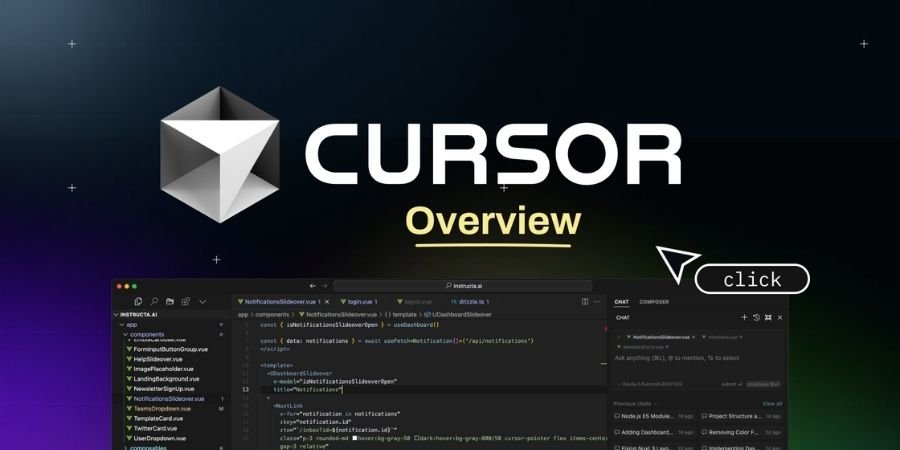
Cursor is a code editor engineered around natural language prompts.
While earlier assistants like Copilot focused on autocompleting the line you were actively typing, Cursor takes in your entire codebase. That single architectural difference means you can ask it to make sweeping, multi-file updates across your project in seconds instead of hunting down broken references manually.
The core reason engineers adopt it so quickly comes down to friction. Switching between browser tabs, terminals, and documentation kills momentum. Cursor keeps searching, command execution, and code editing inside one screen, giving developers a massive 3x to 5x speed boost on routine tasks.
The MIT Team Behind the Software
Anysphere started back in 2022 when four MIT computer science undergrads, Michael Truell, Sualeh Asif, Arvid Lunnemark, and Aman Sanger, decided to rethink dev tools from scratch.
The four met during late-night campus hackathons and research projects at MIT CSAIL. Instead of taking standard corporate software roles after graduation, they pooled their backgrounds in machine learning and system optimization to build an editor where code generation felt native rather than tacked on.
Instead of spending years writing a brand-new text editor from the ground up, they made a strategic decision: fork Visual Studio Code. That move meant 74% of developers could switch over instantly without losing their existing extensions, keybindings, or setups.
The Mechanics Behind Reaching $1B ARR
Scaling to $1 billion in annualized revenue in 24 months requires absurd efficiency. Cursor achieved it through four core mechanics:
1. Solving a painful workflow bottleneck
Engineering leaders wanted faster team output; developers wanted an AI that understood complex repo structures instead of throwing generic snippets. By letting users edit multiple files simultaneously using local context, Cursor turned trial users into power advocates almost overnight.
2. Viral screen recordings over ad spend
The company spent literally $0 on traditional marketing during its early run. Developers simply posted brief screen recordings on X and GitHub showing Cursor AI refactoring massive codebases in real time. Individual engineers bought accounts, showed their teammates, and forced enterprise purchasing teams to buy sitewide licenses.
3. Custom underlying infrastructure
Instead of relying strictly on off-the-shelf LLMs, Anysphere built proprietary internal models like Composer and Cursor-Fast. These models process queries up to four times faster than standard models, while local indexing keeps project structures cached directly on the developer’s machine.
4. A high-converting freemium tier
A new customer gets 2000 trial completions free of charge. If and when the user consumes all the completions they were gifted, the more powerful users become the paid customers by upgrading to the $20/month Pro plan, and for companies $40/user for the team-wide central controls and privacy guarantees. This model resulted in the free-to-paid conversion at the level of 36% which is very roughly 6 to 18 times the normal SaaS benchmarks!
Pricing Tier Comparison
| Tier | Price | Who It’s For | Key Capabilities |
| Hobby | $0 | Students & beginners | 2,000 AI completions, standard processing |
| Pro | $20 / mo | Professional engineers | High-speed model access, unlimited repo indexing |
| Business | $40 / user / mo | Corporate engineering teams | Team admin dashboard, strict data privacy, custom models |
The Journey to a $29B Valuation
Venture firms fought aggressively to join Anysphere’s funding rounds because the company’s metrics didn’t look like typical software startups. Cursor AI generated roughly $3.3 million in ARR per employee. For context, the average public SaaS business sits around $200,000 to $400,000 per employee.
By late 2025, Accel and Coatue co-led a massive $2.3 billion Series D alongside Thrive Capital, Andreessen Horowitz, Nvidia, and Google, valuing Anysphere at $29.3 billion post-money. Revenue continued to surge past $2 billion shortly after.
How Cursor Compares Against GitHub Copilot
| Feature | Cursor (Anysphere) | GitHub Copilot |
| Architecture | Standalone VS Code Fork | IDE Extension / Plugin |
| Multi-File Context | Native Composer System | Basic plugin support |
| Primary Strength | Sub-second multi-file edits & speed | Deep Microsoft ecosystem integration |
| User Experience | Feels like an active co-developer | Operates like smart inline autocomplete |
Key Growth Timeline
- January 2022: Four MIT undergraduates incorporate Anysphere in San Francisco.
- October 2023: OpenAI Startup Fund leads an $8 million seed round.
- August 2024: Annualized revenue crosses $48 million purely through organic developer adoption.
- January 2025: Revenue hits $100 million ARR in 21 months.
- November 2025: Closes a $2.3B Series D at a $29.3B valuation upon hitting $1B ARR.
- Early 2026: Revenue doubles past $2 billion ARR as enterprise adoption expands worldwide.
Core Lessons for Modern Founders
- Solve one hard problem completely: Cursor AI didn’t try to manage project boards, write docs, or run cloud hosting. They focused on making engineers dramatically faster inside their editor.
- Remove onboarding friction: By forking VS Code, they allowed developers to migrate their entire setup in one click rather than forcing them to learn a foreign interface.
- Listen directly to the user base: The co-founders have created short but efficient cycles of collecting customer feedback on Discord where every single developer who raised an issue got a fix the next week instead of just speculating on features that customers would like most.
Common Questions
What makes Cursor AI different from an extension?
Extensions sit on top of an editor with limited system access. Because Cursor is a modified VS Code fork, it directly controls file indexing, keyboard bindings, and terminal commands.
Who owns Anysphere?
Anysphere remains a private company backed by major venture firms like Accel, Coatue, Thrive Capital, and Andreessen Horowitz, alongside strategic investors like Nvidia and Google.
Why did developers switch from Copilot to Cursor AI?
Copilot acts mostly like typing suggestions, while Cursor acts like a real partner capable of writing full multi-file features and fixing errors across your codebase.