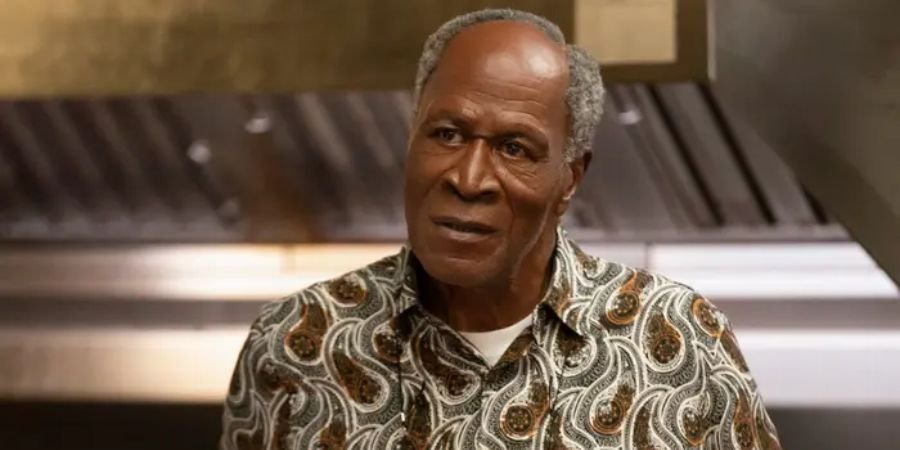
When John Amos passed away on August 21, 2024, at the age of 84, millions of fans stopped and remembered the man who made James Evans Sr. one of the most beloved fathers in television history.
In living rooms across America, his voice carried warmth, discipline, and a working-class pride that felt real because it was real. So when the headlines began circulating about his financial situation in his final years, many fans were left asking the same question: how did a man with such a towering career end up with so little?
That question is exactly why people search for John Amos net worth. His story is about far more than a dollar figure. It is about the economics of Black Hollywood in the 1970s, the price of having principles, and what decades of hard work can and cannot guarantee in the entertainment industry.
John Amos Net Worth: The Overview
At the time of his death, John Amos net worth was estimated at approximately $300,000, according to Celebrity Net Worth. Some outlets placed the figure closer to $3 million, though the lower estimate is more widely cited given documented financial struggles including a home foreclosure.
For a man who appeared in some of the most iconic productions in American television and film history, the number surprises people. Understanding why requires looking at the full arc of his life.
Quick Facts:
- Full Name: John Allen Amos Jr.
- Born: December 27, 1939, Newark, New Jersey
- Died: August 21, 2024, Los Angeles, California (age 84)
- Estimated Net Worth at Death: $300,000–$3 million
- Primary Income Sources: Television, film, theater, voice work, music
- Most Famous Role: James Evans Sr. on Good Times (CBS, 1974–1976)
Early Life and Career Beginnings: From Newark to the Field
John Amos grew up in East Orange, New Jersey, the son of an auto mechanic named John Amos Sr. and his wife Annabelle. There was nothing in his childhood that pointed inevitably toward Hollywood stardom. Instead, what defined him early was grit and athleticism.
After graduating from East Orange High School in 1958, he attended Long Beach City College in California before earning a degree in sociology from Colorado State University.
At Colorado State, he was a standout football player and went on to become a Golden Gloves boxing champion, a detail that says everything about the kind of man he was: someone who showed up, trained hard, and competed.
In 1964, he signed as a free agent with the Denver Broncos. A pulled hamstring on the second day of training camp ended that chapter before it began. He bounced through minor leagues and eventually had a brief stint with the Kansas City Chiefs in 1967. He also served in the 50th Armored Division of the New Jersey National Guard and was later named Honorary Master Chief of the United States Coast Guard.
When football closed its doors, Amos did what many athletes of his generation did not: he reinvented himself entirely. He worked as a social worker, wrote advertising copy, and eventually drifted into stand-up comedy and small acting roles. The transition was slow, humbling, and financially uncertain. John Amos earnings from acting were modest at best.
The Breakthrough: Good Times and the Role That Changed Everything
The real turning point in John Amos net worth and visibility came through a weatherman. In 1970, he landed the recurring role of Gordy Howard, the cheerful weatherman on The Mary Tyler Moore Show. He held that role from 1970 to 1973, gaining experience, exposure, and a foothold in network television.
Then came Good Times.
The CBS sitcom premiered in 1974, a spinoff of Maude that centered on the Evans family, a Black working-class household living in a Chicago housing project. Amos played James Evans Sr., the proud, hardworking patriarch who held his family together through poverty and persistence.
The show was groundbreaking. It was one of the first primetime programs to center an entire African American family in an honest, non-stereotyped light.
Amos appeared in 61 episodes between 1974 and 1976. His portrayal of a man who worked multiple jobs, refused to compromise his dignity, and believed fiercely in his children resonated with an entire generation of Black American families who finally saw themselves reflected on screen.
John Amos salary during Good Times was consistent with network television rates of the mid-1970s. While specific per-episode figures were never publicly disclosed, network cast members of comparable shows in that era typically earned between $5,000 and $15,000 per episode.
For a 61-episode run, that represents a meaningful but not extraordinary income by Hollywood standards, especially before residual structures became more favorable to actors.
The problem was not the paycheck. The problem was what came next.
Amos grew increasingly frustrated with the show’s writers, a predominantly white creative team, who he felt were undermining the dignity of the Black characters, particularly his own, in favor of cheap comedy driven by Jimmie Walker’s character, J.J. Evans. He clashed with producers. He pushed back on storylines. He advocated loudly for the show to honor its original premise.
In 1976, he was fired.
It was a decision that cost him the height of his commercial earning power at the exact moment his face was in millions of American homes every week. The dismissal is widely seen as one of the key reasons his long-term john amos wealth never matched his cultural impact.
Roots, Film Career, and the Years That Followed
The year after Good Times, something remarkable happened. Amos was cast in Roots, the landmark 1977 ABC miniseries based on Alex Haley’s novel about an African American family’s history from slavery to freedom. Amos played the adult Kunta Kinte, one of the most emotionally demanding roles in American television history.
The miniseries was watched by over 130 million people across its broadcast run. It won nine Emmy Awards. Amos himself received an Emmy nomination for Outstanding Lead Actor in a Limited Series, recognition that cemented his reputation as one of the most capable dramatic actors of his generation even if the award itself went to someone else.
Roots did not make him rich in the immediate sense, but it made him undeniable.
Through the 1980s and 1990s, Amos maintained a steady presence across film and television:
- Let’s Do It Again (1975) – appeared alongside Sidney Poitier and Bill Cosby
- Coming to America (1988) – played Cleo McDowell, the fast-food restaurant owner, alongside Eddie Murphy in one of the highest-grossing comedies of the decade
- Die Hard 2 (1990) – played Major Grant in the blockbuster action sequel
- Coming 2 America (2021) – reprised his role for the Amazon Prime sequel, showing studios still valued his presence decades later
Television work continued with appearances on The A-Team, Sanford & Son, All in the Family, The Fresh Prince of Bel-Air, The West Wing, and The District. Each appearance contributed to John Amos earnings but in the episodic, fragmented way that characterizes most working actors’ careers, meaningful income that rarely accumulates into generational wealth.
His final acting appearance came in The Last Rifleman (2023), a British film released just a year before his death. He was working almost until the end.
Theater, Music, and Other Income Streams
What sets John Amos apart from many of his peers is that he never limited himself to screen acting. He pursued theater with genuine passion, writing and performing Halley’s Comet, a one-man show that toured internationally. The play demonstrated his range and kept him connected to live performance throughout his career.
He also performed in August Wilson’s Gem of the Ocean both on Broadway and at McCarter Theatre in Princeton, New Jersey, the kind of serious theatrical work that builds critical reputation even when it does not generate blockbuster income.
In 2009, Amos released a country music album, adding yet another unexpected dimension to his career and john amos fortune. It was a modest commercial venture but reflected his lifelong refusal to be confined to a single creative lane.
Voice work for animated series and commercials also supplemented his income over the years, as did speaking engagements and personal appearances tied to his cultural legacy.
Awards, Recognition, and the Legacy Premium
Recognition has a financial value, even when it arrives late. Over the course of his career, John Amos accumulated significant industry honors:
- Emmy nomination for Roots (1977)
- CableACE Award nomination
- DVD Exclusive Award nomination
- NAACP Image Award nomination
- Three TV Land Awards
- Induction into the New Jersey Hall of Fame (2020)
Each of these recognitions helped sustain his visibility and marketability, opening doors for later roles that continued adding to John Amos net worth. The 2020 Hall of Fame induction in particular came during a period when his health was reportedly declining, yet it signaled that the industry still considered him a significant figure.
Looking at John Amos net worth forbes-style rankings, he never appeared on lists of Hollywood’s wealthiest actors. His wealth was always more cultural than financial, a distinction the entertainment industry rarely rewards adequately.
Personal Life and the Decisions That Shaped His Finances
John Amos married twice. His first marriage was to Noel J. Mickelson, with whom he had two children: daughter Shannon Amos, born in 1966, and son Kelly Christopher “K.C.” Amos, born in 1970. The marriage ended in divorce in 1975. In 1978, he married actress Lillian Lehman, but that marriage also ended in divorce the following year.
The question of John Amos net worth wife and family is complicated by events that became public near the end of his life. In June 2023, his daughter Shannon launched a GoFundMe campaign with a $500,000 goal, claiming her father had been the victim of elder and financial abuse. She alleged that his home had been stripped of valuables and that he was in poor health.
Amos publicly disputed the claims, stating he was recovering from a medical issue and had not been abused. His son K.C., who was his primary caregiver, also denied the allegations. The LAPD investigated and officially closed the case in April 2024 due to lack of evidence.
Regarding John Amos net worth son, K.C. Amos was the one who announced his father’s death on October 1, 2024, more than five weeks after John Amos had actually passed on August 21. The unusual delay added a painful layer of public scrutiny to an already complicated family dynamic.
There was also the matter of real estate. In 1990, Amos purchased a home in Lebanon, New Jersey, for $337,000. He listed it for $439,000 in December 2016 but could not find a buyer. By 2018, the property had slipped into foreclosure.
It eventually sold in April 2021 for $288,000, less than he had originally paid for it over 30 years earlier. The loss represented not just a financial setback but a symbol of the broader economic precarity that shadowed his later years.
Comparing John Amos to Peers of His Era
To understand John Amos net worth celebrity in context, it helps to look at his contemporaries. Actors like James Earl Jones, who built a similar foundation in prestige television and film during the same era, accumulated significantly greater wealth, reportedly in the range of $40 million by the end of his career.
The difference comes down to several factors: consistent leading roles, franchise involvement, voice work with major studios, and the compound effect of residuals from long-running properties.
Esther Rolle, his Good Times co-star, reportedly had a net worth of around $500,000 at the time of her death in 1998, a figure that underscores how the show’s cast, despite its cultural impact, was not compensated with the kind of salaries that accumulate into lasting wealth.
This was a structural reality of Black Hollywood in the 1970s. Groundbreaking representation came at wages that did not reflect the shows’ commercial success or cultural significance. The economics of residuals also worked differently then, and many actors who built their names in 1970s network television found that the royalties from those years were not structured to provide long-term financial security.
John Amos Net Worth: A Timeline of Financial Growth and Setbacks
- 1964–1967: Professional football career, minimal earnings from minor league play.
- 1970–1973: First major TV role on The Mary Tyler Moore Show. Steady television income begins.
- 1974–1976: Good Times – peak visibility and strongest sustained John Amos salary of his career. Estimated 61-episode income in the hundreds of thousands.
- 1977: Roots – Emmy nomination boosts prestige but does not dramatically alter finances.
- 1975–1990s: Steady film and television work. Notable roles in Coming to America and Die Hard 2 supplement income.
- 1990: Purchases Lebanon, New Jersey home for $337,000, largest documented asset.
- 2000s–2010s: Broadway work, continued television appearances, country music album (2009), international theater touring.
- 2016: Lists New Jersey home for $439,000. No buyer found.
- 2018: Home enters foreclosure. Relocates to Colorado.
- 2021: Home sells at foreclosure for $288,000.
- 2023: GoFundMe controversy; elder abuse allegations made and disputed.
- 2024 (August 21): Passes away in Los Angeles. John amos net worth at time of death estimated at $300,000.
What Was John Amos Net Worth – And What It Really Means
The question what was John Amos net worth deserves a fuller answer than a single number. At $300,000, it reflects a man who worked for over 50 years in an industry that routinely underpaid Black talent in the decades when he was most productive.
It reflects a career that prioritized artistic integrity, he was fired from Good Times specifically because he refused to let his character be diminished, over commercial accommodation.
John amos net worth when he died stands as a commentary on an industry, not a verdict on a man. His cultural net worth, the millions of children who saw a Black father on television who was strong, loving, employed, and dignified, was immeasurable.
Discussions of john shelby amos net worth and john b amos net worth (references to his full legal name, John Allen Amos Jr.) consistently point to the same documented estimate, reinforcing that the $300,000 figure represents the most credible publicly available assessment of his estate at the time of death.
The separate individual sometimes referenced as john amos aflac net worth refers to a different person entirely, John B. Amos was a co-founder of the insurance company Aflac and is unrelated to the actor.
John amos net worth currently is, of course, a figure that no longer applies in the traditional sense, his estate carries his legacy forward. His work continues to stream, be licensed, and be studied, which means residuals and licensing fees continue to generate income for his estate.
The Lasting Legacy
John Amos spent five decades giving audiences characters who mattered. James Evans Sr. showed a generation that Black fathers were present. Kunta Kinte showed a nation what survival through brutality looked like with dignity intact. Cleo McDowell made people laugh at something joyful. General Esperanza made blockbusters bigger.
He wrote plays that toured the world. He released music at 70. He kept acting at 83. He never stopped.
John amos fortune in cultural terms dwarfs anything a bank account could hold. He changed what American television looked like, challenged writers who tried to make his characters small, and built a body of work that will be studied and celebrated long after the financial details are forgotten.
That is the fuller picture of John Amos net worth, a man whose contributions to American culture are priceless, even as the industry he served did not always price him accordingly.
FAQ: John Amos Net Worth
What was John Amos net worth at the time of death?
John Amos net worth at time of death was estimated at approximately $300,000 by Celebrity Net Worth. Some outlets suggested it could be as high as $3 million, though the lower figure is more widely cited due to documented financial challenges in his final years.
How did John Amos make his money?
John Amos earned his income primarily through television acting, film appearances, Broadway theater, international one-man show touring, voice work, and a country music album released in 2009. His most lucrative television work included Good Times, Roots, The West Wing, and recurring guest roles across dozens of shows.
Why did John Amos leave Good Times?
John Amos clashed with the show’s writing staff over storylines he believed undermined the dignity of his Black characters. He felt the show was drifting toward cheap comedy at the expense of authentic representation. The conflict led to his dismissal in 1976 after 61 episodes.
Did John Amos win an Emmy?
John Amos received an Emmy nomination for Outstanding Lead Actor in a Limited Series for his performance in Roots (1977) but did not win. He received multiple other nominations throughout his career and won three TV Land Awards.
What happened to John Amos’s house?
John Amos purchased a home in Lebanon, New Jersey in 1990 for $337,000. After failing to sell it at $439,000 in 2016, the property entered foreclosure in 2018 and eventually sold in April 2021 for $288,000, a financial loss on his largest known asset.
Is John Amos related to the founder of Aflac?
No. John B. Amos, the co-founder of Aflac insurance, is a different person entirely. Questions about john amos aflac net worth conflate two unrelated individuals with similar names.
Who announced John Amos’s death?
John Amos son, K.C. Amos, announced his father’s death on October 1, 2024, more than five weeks after John Amos had passed on August 21, 2024.
What was John Amos’s last acting role?
John Amos final film appearance was in The Last Rifleman (2023), a British production released just a year before his death, demonstrating his commitment to his craft well into his 80s.
How does John Amos net worth compare to other actors from his era?
John Amos net worth was modest compared to contemporaries like James Earl Jones (estimated $40 million). The gap reflects structural inequities in how Black actors in 1970s network television were compensated, as well as the difference between supporting/recurring roles and sustained leading roles in franchise properties.
Read Also: Paradise Season 2: Official Release Date Confirmed