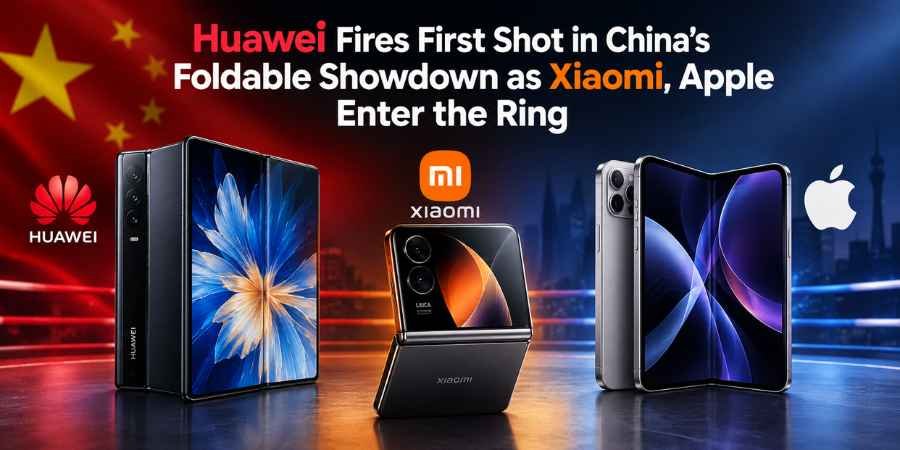
China’s premium smartphone market kicked off its most consequential week of the year on Monday, with Huawei launching a new version of its flagship foldable smartphone as it seeks to defend its lead against Apple and Xiaomi, both of which are also unveiling new products.
Highlights
- The new Mate XT2 series folds out twice to open into a tablet-sized screen and runs on Huawei’s new Kirin 9050 Pro chip.
- Prices start from 19,999 yuan ($2,980), rising to 24,999 yuan ($3,725) for the top configuration, with sales beginning September 12.
- The device adds a redesigned folding mechanism, improved water resistance, and an optional privacy screen that blocks nearby onlookers from seeing the display.
- It is the first Huawei device built on the company’s new “LogicFolding” chip design philosophy, part of the wider Tau Scaling Law framework.
- Xiaomi countered hours later with its own 18-Fold, a passport-sized “mid-fold” powered by an in-house chip rather than Qualcomm silicon.
- Apple is set to unveil its iPhone lineup on Wednesday, with strong expectations of a first-ever foldable iPhone.
Background
Huawei’s push comes as it tries to hold onto ground it has spent years defending under pressure. The company leads China’s smartphone market with a 22.6% share in the second quarter, ahead of Apple’s 18.1%, according to IDC, while Xiaomi holds 12.4%. In folding phones specifically, Huawei is even more dominant, accounting for 68% of shipments in China in the second quarter, according to Smart Analytics Global.
That dominance exists despite, or arguably because of, Washington’s restrictions. Huawei is barred from selling in the US, as Washington has deemed the company a national security risk, forcing it to design around the loss of access to leading-edge chipmaking.
Huawei says the Kirin 9050 Pro’s architecture delivers more computing power while using less electricity, and executive Richard Yu was candid about what that engineering has cost the company financially: “Pricing right now is a real challenge, because memory costs have risen sharply. We adopted a lot of new technology, and the cost pressure has been enormous.”
That pricing pain is not Huawei’s alone. Rising memory costs have pushed Huawei, Xiaomi and Honor to all raise smartphone prices this month, according to Chinese outlet Jiemian, a squeeze playing out against a brutal industry backdrop, with Counterpoint tracking global shipments toward their steepest annual contraction on record, roughly 14% this year, hitting budget-focused Chinese brands hardest.
Xiaomi’s answer arrived the same day. Rather than chase Huawei’s tri-fold format, Xiaomi built the 18-Fold around a “mid-fold” concept, smaller than a book-style Galaxy Z Fold, roomier than a flip phone. Folded, it’s roughly passport-sized with a 5.38-inch cover screen; opened, it reveals a 7.58-inch inner display in a near-4:3 ratio built for split-screen work.
Notably, it skips Qualcomm entirely in favor of Xiaomi’s own 3-nanometer XRing O3 processor, paired with what’s claimed to be the world’s first commercial use of CXMT-made LPDDR6 memory, a bandwidth jump of roughly 50% over the previous generation. Leica-tuned triple cameras, a new “dragon bone” hinge, a 6,000mAh battery and 67W wired charging round out the package, priced from around ¥12,000 ($1,650). As with prior Mix Fold models, Xiaomi has given no indication the 18-Fold will leave China.
The wildcard is Apple. Rumors of a folding iPhone have circulated for years, but this week is shaping up as the moment Apple finally answers Samsung, which has sold foldables since 2019, and Huawei, which has iterated on tri-folds since introducing the original Mate XT two years ago.
Samsung itself tested the tri-fold waters in December with a launch that reportedly lasted only three months before being quietly discontinued, though it broadened its foldable lineup in July with a smaller, passport-sized model, suggesting even the segment leader is still hunting for the format that sticks.
Industry projections from Smart Analytics Global reportedly see Apple capturing around a quarter of the global foldable market in its debut year, climbing toward a leading share the year after, a forecast that, if realized, would upend a category China’s brands have largely had to themselves.
Key Takeaways
- Huawei is defending, not expanding, its Mate XT2 pricing reflects surging memory costs squeezing the entire Chinese smartphone industry, not just Huawei.
- Xiaomi is differentiating on format and silicon, betting a mid-size fold and self-designed chip can carve out space Huawei’s tri-fold doesn’t cover.
- US sanctions have become a design constraint Huawei has turned into a marketing narrative, framing chip limitations as engineering innovation.
- Apple’s entry is the real inflection point, analysts expect it to reshape global foldable market share within two years, even as China’s incumbents move first.
- The global smartphone market’s broader contraction means this is not a growth story so much as three giants fighting harder for a shrinking, pricier premium segment.
- None of Huawei’s, Xiaomi’s, or (likely) Apple’s new foldables will be available in the US in the near term, leaving American consumers watching from the sidelines.