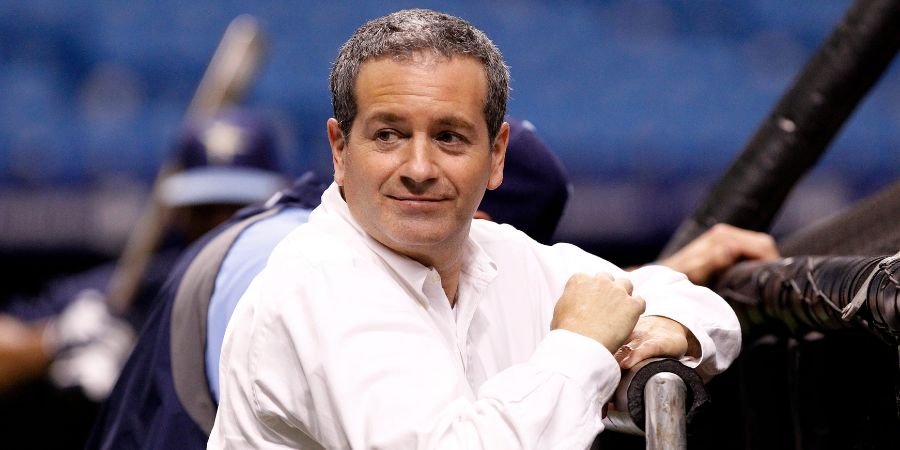
Stuart L. Sternberg bought a broken baseball team for $200 million in 2004 and sold it for $1.7 billion in 2025. In between, he turned one of baseball’s worst franchises into one of its most innovative, and spent 20 years failing to build a stadium.
That is the Stuart Sternberg story in two sentences.
But the full picture is more complicated. Tampa Bay Rays ownership history under Sternberg includes two World Series appearances, nine playoff runs, a revolutionary analytics model that the whole league copied, and one of the messiest stadium sagas in professional sports.
So who is Stuart Sternberg? A visionary owner who changed how baseball thinks about building a team? A bottom-line businessman who kept payroll too low for too long? Someone who genuinely tried to keep the Rays in Tampa Bay, or someone who used relocation threats as leverage?
He was all of these things. Here is an honest breakdown.
From Goldman Sachs to the Dugout: Stuart Sternberg’s Background
Stuart L. Sternberg was born August 8, 1959, in Brooklyn, New York. He grew up in the Canarsie neighborhood, the youngest of three kids whose parents ran a pillow shop on Flatbush Avenue. His first Major League Baseball game was at Shea Stadium in 1965, watching Sandy Koufax pitch. He never forgot it.
How did Stuart Sternberg make his money? Through a 25-year career on Wall Street. He started trading equity options part-time at the American Stock Exchange while still studying finance at St. John’s University in 1978. After graduating, he joined investment firm Spear, Leeds & Kellogg, eventually becoming a partner. When Goldman Sachs acquired the firm in 2000 for $6.5 billion, that transaction significantly increased Sternberg’s personal wealth. He retired from Goldman Sachs as a partner in 2002.
Two years later, he bought into baseball.
In May 2004, Sternberg acquired a 48% stake in the Tampa Bay Devil Rays from Vince Naimoli. He took over as Managing General Partner in October 2005, partnering with fellow Goldman Sachs colleague Matthew Silverman as team president. The franchise had never posted a winning record. Its previous owner was widely disliked by players, staff, and fans alike.
Sternberg came in with a clear mandate: fix the culture first, then fix the team.
Stuart L. Sternberg net worth is estimated at around $800 to $900 million as of 2025, primarily from his share of the $1.7 billion Rays sale and his prior Wall Street career. He lives in Rye, New York with his wife, Lisa Kampfmann Sternberg, and their four children: Sanford, Jake, Natalie, and Ella.
10 Things Stuart Sternberg Did Right (and Wrong)
RIGHT #1: He Fixed a Toxic Culture Immediately
When Sternberg walked in, the Tampa Bay Devil Rays were a mess, not just in the standings, but in how the organization operated. The previous ownership had created an environment that drove away talent and built distrust at every level.
Sternberg changed that quickly. He hired smart, analytically minded people. He created a culture where ideas were welcome regardless of where they came from. He treated the front office like a business, not a fiefdom.
Internally, this made a real difference. When Sternberg sold the team in 2025, a group of longtime Rays employees was reportedly so troubled by the backlash against him that they wrote a letter defending his character, not something you typically see when an owner leaves.
He brought focus, professionalism, and respect to an organization that had very little of any of those things before he arrived.
RIGHT #2: He Hired the Right People and Trusted Them
In 2005, Sternberg brought in Andrew Friedman as general manager. Friedman had no prior GM experience. Sternberg gave him the job anyway.
That decision paid off immediately. Friedman, alongside manager Joe Maddon, built the 2008 Rays team that went from 66 wins the year before to 97 wins and an American League pennant. They reached the World Series in just Sternberg’s third full season.
Sternberg’s approach was consistent with how he operated at Goldman Sachs: hire sharp people, give them autonomy, and hold them accountable for results. He rarely second-guessed his front office on baseball decisions. That trust created a stable environment where creative thinking flourished.
When Friedman left for the Los Angeles Dodgers in 2014, the culture he built remained. The Rays kept finding new edges, the opener pitching strategy, aggressive defensive shifts, aggressive use of the minor league system to stay competitive without big contracts.
RIGHT #3: He Turned the Rays Into a Baseball Innovation Lab
Under Stuart Sternberg, the Tampa Bay Rays became the most analytically creative franchise in Major League Baseball. They had to be. With payroll that regularly ranked in the bottom five of the league, they could not simply buy their way to wins.
So they found other ways. The Rays were early adopters of defensive shifts. In 2018, Sergio Romo came out as the starting pitcher in Game 1 of the ALDS, not to pitch a full inning, but to face the top of the Oakland lineup before giving way to a traditional starter. This “opener” strategy was used for the first time in MLB history, and it works specifically because it exploits matchup advantages that traditional pitching rotations ignore.
The rest of baseball eventually copied it. Today the opener is a standard tool in most bullpens.
The Rays also led the league in finding undervalued pitching, rebuilding careers, and developing position players who other teams had given up on. Baseball America named the Rays their MLB organization of the year three separate times during Sternberg’s tenure.
From 2008 through 2025, the Rays posted the third-best winning percentage in all of Major League Baseball. With the third-lowest average payroll.
RIGHT #4: He Grew the Franchise Value Dramatically
Stuart Sternberg paid $200 million for the Tampa Bay Devil Rays in 2004. He sold the Tampa Bay Rays in 2025 for $1.7 billion.
That is a more than 8x return on investment over 20 years.
Forbes valued the franchise at $145 million when Sternberg became principal owner in 2005. By March 2025, they valued it at $1.25 billion. The final sale price of $1.7 billion exceeded that estimate.
Part of this was just MLB franchise values rising across the board. But part of it was specifically the Rays brand, built on sustained winning, smart operations, and league-wide respect for the front office approach Sternberg built and funded.
RIGHT #5: He Walked Away With Class
When the end came, Sternberg handled it well.
He sold it to a group led by Jacksonville developer Patrick Zalupski, CEO of Dream Finders Homes, rather than to the highest bidder. His stated reason: Zalupski gave the Rays the best chance of staying in Tampa Bay. Sternberg and his partners retained roughly a 10% minority stake in the team.
After the sale closed on September 30, 2025, Sternberg provided cash bonuses to every full-time employee in the organization, more than 500 people. The bonuses were tenure-based. Some longtime scouts and minor league coaches who had worked with the club for over a decade received a full year’s salary.
That is not what a man who only cared about the bottom line does on his way out the door.
WRONG #1: He Kept the Payroll Too Low for Too Long
This is the central complaint about Sternberg’s ownership, and it is legitimate.
The Rays’ payroll frequently ranked last or near last in MLB. Between 2019 and 2023, they made the playoffs five straight years, and routinely watched their best players leave once they hit free agency or arbitration, because the team would not or could not pay them.
Evan Longoria. David Price. James Shields. Blake Snell. Carlos Gomez. Wander Franco (his own complicated situation aside), the pattern was consistent. The Rays developed players, proved their value, then let them go.
Fans accepted this for a while. It was harder to accept when the Rays were going to the playoffs every year and still could not put together a competitive payroll. By the early 2020s, the gap between what Tampa Bay spent and what even mid-market teams spent was glaring.
To be fair, attendance at Tropicana Field was chronically poor. The economics of a small market in a dome stadium with limited corporate revenue are genuinely difficult. But even accounting for that, the payroll decisions frustrated fans and limited what the team could accomplish in October.
WRONG #2: He Never Solved the Stadium Problem
This is Sternberg’s defining failure, and it took 20 years to become undeniable.
The Tampa Bay Rays stadium controversy started almost immediately after Sternberg took over. Tropicana Field was outdated, poorly located for much of the Tampa Bay market, and a documented attendance problem. The Rays needed a new ballpark.
What followed was two decades of proposals, negotiations, false starts, political conflicts, and broken deals. The Ybor City stadium plan in 2018 collapsed. The Gas Plant District stadium, a $1.3 billion project that finally seemed real after Pinellas County approved public financing in July 2024, died when Hurricane Milton tore the roof off Tropicana Field in October 2024, creating funding uncertainty that derailed the entire timeline.
In March 2025, Sternberg pulled the plug. The deal was dead. The Rays played the 2025 season at Steinbrenner Field, an 11,000-seat spring training venue, because their actual stadium had no roof. It was the most visible symbol of everything that had gone wrong.
MLB commissioner Rob Manfred had reportedly been pressuring Sternberg to sell the team even before the stadium collapse became final, recognizing that the franchise needed new ownership to move forward.
Sternberg himself acknowledged it: “My time had come.”
WRONG #3: The Montreal Split-Season Idea Alienated Tampa
In 2019, the Rays unveiled a plan to split their home schedule between Tampa Bay and Montreal, roughly 30 games per city per year, with the two cities sharing one franchise.
On paper, the logic was not completely crazy. Two markets that each struggle to support a full-season baseball team might together form something financially viable. MLB has been interested in returning to Montreal since the Expos left in 2004.
In practice, it landed terribly in Tampa Bay.
Sternberg and Rays leadership invited Montreal investors to their 2019 ALDS home games and hung banners inside Tropicana Field celebrating the Montreal partnership. Tampa Bay fans, who had been told repeatedly that the team was committed to staying, saw it as a betrayal. The trust that had been built through years of winning eroded quickly.
The plan never moved forward. But the damage to the relationship between ownership and the fan base lingered. Critics argued Sternberg was using Montreal as leverage to pressure St. Petersburg into stadium concessions, not pursuing it as a genuine solution.
Whether that was the intent or not, it felt that way, and in the Tampa Bay market, it made an already difficult stadium conversation much harder.
WRONG #4: The Communication Style Created Unnecessary Conflict
Sternberg was brilliant at baseball strategy. He was less consistent at managing public relationships.
On multiple occasions, Sternberg’s comments about attendance, the stadium situation, or the franchise’s financial constraints came across as condescending or frustrated rather than collaborative. In a 2011 interview, he openly speculated about whether the Rays could survive in Tampa Bay at all, saying baseball “won’t find a place here.”
That kind of honesty can be admirable. It can also be counterproductive when you are simultaneously trying to negotiate with the local government for hundreds of millions of dollars in public stadium funding.
Ray’s leadership also let their frustration show in ways that cost them politically. By the end of Sternberg’s tenure, the relationship with St. Petersburg city officials was strained enough that after the stadium deal collapsed, the mayor’s statement did not hide the animosity.
The stadium was always going to be hard. The communication made it harder.
WRONG #5: He Held On Too Long
By 2023 and 2024, it was clear that the Rays under Sternberg had reached a ceiling. The stadium situation was intractable. The team had back-to-back losing seasons. The innovative culture was still there, but the momentum had stalled.
Multiple people inside and outside MLB had come to the same conclusion: the franchise needed new ownership to break the political deadlock and get a stadium built.
Sternberg eventually reached that conclusion too, but it took Hurricane Milton, a collapsed stadium deal, and pressure from the MLB commissioner to get there.
Had he sold two or three years earlier, the transition might have been cleaner and the Gas Plant District deal might have survived. The 2025 season at an 11,000-seat spring training park, and the public embarrassment that came with it, might have been avoided.
Sternberg said in his farewell that he was “70/30 glad” he was selling, other days “70/30 wishing he wasn’t.” That ambivalence, visible throughout his last two years, may have cost the franchise and the community real time and real money.
Stuart Sternberg’s Ownership: By the Numbers
| Stat | Number |
| Purchase price (2004) | $200 million |
| Sale price (2025) | $1.7 billion |
| Franchise value increase | ~750% |
| Playoff appearances | 9 |
| AL Pennants | 2 (2008, 2020) |
| AL East titles | 4 |
| 100-win season | 1 (2021) |
| Win-loss record (2005–2025) | 1,717–1,583 (.520) |
| Win % before Sternberg (1997–2004) | 0.398 |
| Baseball America Org. of Year awards | 3 |
| Payroll ranking (typical) | Bottom 5 in MLB |
Timeline: Key Events of the Sternberg Era
- 2004: Sternberg buys 48% stake in the Devil Rays from Vince Naimoli for approximately $200 million.
- 2005: Takes over as Managing General Partner. Hires Matthew Silverman as team president.
- 2006: Andrew Friedman named GM. Joe Maddon becomes manager.
- 2008: Drops “Devil” from name. Team goes 97-65, wins AL East and AL pennant. Loses World Series to Philadelphia Phillies.
- 2010: Wins AL East again.
- 2011: Sternberg publicly questions the Rays’ long-term viability in Tampa Bay.
- 2014: Andrew Friedman departs for the Dodgers. Kevin Cash hired as manager.
- 2018: Ybor City stadium plan collapses. Rays introduce the opener pitching strategy.
- 2019: Montreal “sister city” split-season plan announced. Fans react badly.
- 2020: Rays reach World Series for second time; lose to Los Angeles Dodgers.
- 2021: Rays go 100-62, best record in franchise history.
- 2023: Gas Plant District stadium deal announced: $1.3 billion project adjacent to Tropicana Field.
- October 2024: Hurricane Milton destroys Tropicana Field’s roof. Stadium deal begins to unravel.
- March 2025: Sternberg pulls out of Gas Plant District stadium deal. MLB reportedly pressures him to sell.
- June 2025: Rays announce exclusive sale discussions with Patrick Zalupski group.
- July 2025: Sale agreed in principle: approximately $1.7 billion.
- September 30, 2025: Sale finalized. Sternberg era ends after 20 years.
Frequently Asked Questions
Who is Stuart Sternberg?
Stuart L. Sternberg is an American investor and former Wall Street partner who served as the principal owner of the Tampa Bay Rays from 2005 to 2025. He grew up in Brooklyn, New York, attended St. John’s University, and built his career at investment firm Spear, Leeds & Kellogg and later Goldman Sachs, retiring as a partner in 2002. He bought into the Rays in 2004 and spent 20 years building one of MLB’s most analytically innovative franchises.
How did Stuart Sternberg make his money?
Primarily through his career as a Wall Street investor. He became a partner at Spear, Leeds & Kellogg, then moved to Goldman Sachs. When Goldman acquired his former firm for $6.5 billion in 2000, that deal significantly boosted his personal wealth. He retired from Goldman Sachs in 2002 and two years later began buying into the Rays.
Why did Stu Sternberg sell the Rays?
The collapse of the $1.3 billion Gas Plant District stadium deal in March 2025 was the immediate trigger. Hurricane Milton had damaged Tropicana Field in October 2024, delaying bond approvals and making the construction timeline impossible to meet. Sternberg also acknowledged that a different owner might have a clearer path to getting a new stadium built. MLB commissioner Rob Manfred had reportedly been pressuring him to sell. Sternberg’s own words: “My time had come.”
How much is Stuart Sternberg worth?
His Stuart L. Sternberg net worth is estimated at approximately $800 to $900 million as of 2025. His 48% stake in the $1.7 billion sale of the Rays was worth roughly $800 million. That figure does not include his prior Wall Street earnings or other investments.
Who is Lisa Kampfmann Sternberg?
Lisa Kampfmann Sternberg is Stuart Sternberg’s wife. The couple lives in Rye, New York. They have four children together: Sanford, Jake, Natalie, and Ella. Sternberg coached both of his sons’ Little League teams for five years.
What political party is Stuart Sternberg affiliated with?
Sternberg has kept a low public profile on politics and has not made his party affiliation a significant part of his public identity.
Who is Patrick Zalupski?
Patrick Zalupski is the CEO of Dream Finders Homes, a Jacksonville-based residential construction company. He led the ownership group that purchased the Tampa Bay Rays from Sternberg for approximately $1.7 billion in 2025. Sternberg specifically chose Zalupski over other bidders because he believed Zalupski gave the Rays the best chance of remaining in the Tampa Bay area.
What is Stuart Sternberg’s legacy with the Rays?
The Stuart Sternberg legacy is split. On the field: two AL pennants, nine playoff appearances, and a .520 winning percentage that ranks third-best in MLB during that span, all with one of the league’s lowest payrolls. Off the field: a stadium saga that lasted his entire ownership and ended without resolution, a fan base that felt perpetually underfunded, and a franchise sale partly driven by his inability to break the stadium deadlock.
The Honest Verdict on Stuart Sternberg
He bought a disaster and made it something to be proud of on the field.
He never solved the stadium. And the stadium is what matters most for the long-term health of a franchise.
The Tampa Bay Rays stadium controversy was the wound that never healed under his ownership. Every other success, the analytics revolution, the player development, the competitive record, was overshadowed by years of watching a team that deserved a better building never get one.
Sternberg is not a villain. He is not a hero either. He is a complicated owner who got a lot of hard things right and failed at the one thing that required political skill and community trust more than financial discipline.
The next chapter for the Rays belongs to Patrick Zalupski. Whether the team gets a new stadium, and whether it stays in Tampa Bay, will define the Zalupski era the same way it defined Sternberg’s.
The lesson Sternberg leaves behind: winning on the field is necessary. It is not sufficient.