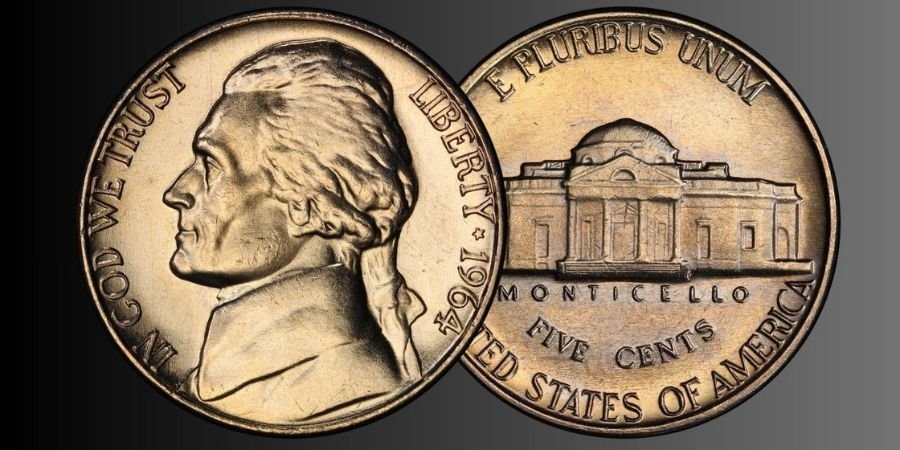
The 1964 nickel error list includes some of the most valuable and sought-after modern coin errors in American numismatics. With over 1.7 billion nickels minted during this crucial transitional year in U.S. coinage history, numerous minting mistakes occurred, creating rare varieties worth far more than five cents.
Accurate identification is crucial for coin collectors because distinguishing between a common circulated nickel and a rare error variety can mean the difference between five cents and tens of thousands of dollars. Coin value app like CoinKnow can help you identify these errors instantly, provide professional grading, and determine accurate market values.
Rare 1964 Nickel Error List & Value
-
1964 Nickel SMS (Special Mint Set) Error
The 1964 nickel SMS represents the holy grail of Jefferson nickel collecting and stands as the most valuable variety in the entire series. These special strikes were experimental prototypes with superior strike quality, showing sharp details and a distinctive matte proof-like finish that sets them apart from regular circulation strikes.
Fewer than 40 examples are believed to exist, making this one of the rarest modern U.S. coins. The combination of extreme rarity and historical significance as a prototype creates extraordinary demand among advanced collectors.
Values are exceptional, with specimens featuring Full Steps designation on Monticello’s staircase reaching over $33,000 at auction. Even examples without Full Steps command five-figure prices when authenticated and graded by major services like PCGS or NGC.
Need help identifying this error and checking its value? CoinKnow offers instant AI-powered identification, professional grading, and real-time market valuations through its comprehensive coin value app.
-
1964-D Nickel Repunched Mint Mark (D/D RPM) Error
The 1964-D repunched mint mark error shows a horizontal “D” beneath the normal vertical “D” mintmark on the reverse. This dramatic error occurred when a mintmark was initially punched horizontally before being corrected with a properly oriented strike, creating a distinctive doubled appearance.
The horizontal alignment of the underlying mintmark is visible under magnification and creates the most desirable Jefferson nickel variety among error collectors. Approximately 20,000 examples are estimated to exist, making it scarce but not impossibly rare.
Values are substantial, with an MS66 specimen holding the auction record at $19,800 sold in July 2022. Lower grade examples still command significant premiums of $100 to $500 depending on condition and clarity of the repunching.
The coin value app from CoinKnow can detect repunched mint marks and distinguish them from die chips or post-mint damage that might appear similar.
-
1964 Nickel Doubled Die Obverse (DDO) Error
Doubled die obverse errors display visible doubling on front-side design elements, particularly noticeable on “LIBERTY,” “IN GOD WE TRUST,” and the date “1964.” This occurs during die production when the hub impresses the design onto the die in slightly misaligned positions.
Under magnification, letters and numbers appear to have a distinct shadow or secondary impression. The doubling shows rounded, raised separation between the primary and secondary images, distinguishing it from mechanical doubling which appears flat and shelf-like.
Values range from $50 for minor doubling visible only under magnification to $1,000 or more for dramatic examples with bold doubling visible to the naked eye. The severity of doubling and overall coin condition significantly impact value.
Need help identifying this error and checking its value? CoinKnow offers instant AI-powered identification, professional grading, and real-time market valuations.
-
1964 Nickel Doubled Die Reverse (DDR) Error
Doubled die reverse errors show doubling on the back side, typically affecting “E PLURIBUS UNUM,” “UNITED STATES OF AMERICA,” “FIVE CENTS,” or the Monticello building itself. Strong examples display spread toward the center on all lettering and architectural features.
Close examination reveals the telltale secondary images that distinguish genuine doubled dies. Multiple varieties exist with varying degrees of doubling, from subtle spreads requiring magnification to dramatic examples showing clear separation.
Values typically range from $50 for minor reverse doubling to $500 or more for pronounced examples affecting multiple design elements. Coins showing doubling on both obverse and reverse command premium prices from variety specialists.
The coin value app technology from CoinKnow includes specialized imaging designed to detect subtle doubled die varieties on both sides of coins.
-
1964 Nickel Off-Center Strike Error
Off-center strikes occur when the blank planchet isn’t properly centered in the striking chamber, causing the design to be impressed partially off the blank. These dramatic errors create coins where part of the design is missing while a corresponding blank crescent appears.
The percentage of misalignment dramatically affects value. Minor off-center strikes of 5-10% add modest premiums, while strikes 30-50% off-center with visible dates are highly desirable and visually impressive.
Values start around $20 for minor misalignments and increase to $1,200 or more for dramatic off-center strikes showing 50%+ displacement. The most valuable examples retain the complete date and mint mark for definitive identification.
Need help identifying this error and checking its value? CoinKnow offers instant AI-powered identification, professional grading, and real-time market valuations.
-
1964 Nickel Die Crack Error
Die crack errors result when the striking die develops cracks from metal fatigue and repeated use. These cracks transfer as raised lines or blobs of metal on finished coins, typically appearing around the rim or crossing design elements.
Small die cracks appear as thin raised lines, while major breaks called “cuds” show as large raised areas where pieces of the die have broken away completely. The location and severity significantly impact collectibility and value.
Values range from $10 for minor cracks showing small raised lines to $50 or more for dramatic die breaks affecting Jefferson’s portrait or major inscriptions. Progressive die cracks showing evolution are particularly interesting to error specialists.
The coin value app from CoinKnow helps distinguish genuine die cracks from post-mint scratches or damage that might appear similar.
-
1964 Nickel Clipped Planchet Error
Clipped planchet errors occur when the blank is improperly punched from the metal strip, resulting in a coin with a curved or straight section missing from its edge. These can be single, double, or even triple clips affecting different portions of the edge.
The clip size and type determine value, with straight clips showing linear edges and curved clips displaying the arc from adjacent punches. Clips affecting important design elements or the date are most desirable.
Values typically range from $20 for small clips removing 5-10% of the planchet to $100 or more for dramatic clips affecting 25%+ of the coin. Multiple clips on a single coin command premium prices from error collectors.
Need help identifying this error and checking its value? CoinKnow offers instant AI-powered identification, professional grading, and real-time market valuations.
-
1964 Nickel Wrong Planchet/Broadstrike Error
Wrong planchet errors occur when nickels are struck on blanks intended for other denominations, such as copper penny planchets. These create coins with incorrect weight, diameter, or composition that’s immediately noticeable when examined.
Broadstrikes happen when the collar that contains the coin during striking malfunctions, allowing the metal to spread beyond normal diameter. These show enlarged, flattened coins with weak or missing edge reeding.
Values for wrong planchet strikes range from $500 to $1,500 or more depending on what planchet was used. Broadstrikes typically command $50 to $300 depending on severity and condition.
The coin value app from CoinKnow includes weight and dimension analysis to help identify potential wrong planchet errors requiring professional authentication.
How Much is a 1964 Nickel Worth? Coin Identifier Apps I Recommended
CoinKnow
CoinKnow delivers industry-leading accuracy for identifying 1964 nickel errors using sophisticated AI technology trained on thousands of authenticated specimens. The app automatically detects rare varieties including SMS strikes, repunched mint marks, doubled dies, and off-center errors within seconds of photo capture.
Key features include instant error detection with detailed explanations, professional-grade condition assessment, and comprehensive collection management tools with portfolio tracking for serious Jefferson nickel collectors building valuable error collections.
CoinValueChecker
CoinValueChecker combines sophisticated error detection with comprehensive market intelligence specifically designed for Jefferson nickels. Beyond identifying errors, it offers in-depth market trend analysis, price tracking across auction platforms, and historical sales data for 1964 varieties.
The app provides robust authentication guidance to help collectors distinguish genuine errors from post-mint damage or alterations. With three free daily scans and detailed grading tutorials, it’s perfect for collectors learning to identify genuine 1964 nickel errors and building investment-grade collections.