The most profitable automotive franchises in 2026 are not necessarily the ones with the lowest startup costs. The better question is how much revenue a franchise can generate relative to the capital required, ongoing royalties, operating model and local demand.
Current 2026 franchise and FDD data put several established names on the shortlist, including Jiffy Lube, Midas, Meineke, Big O Tires, Valvoline Instant Oil Change, CARSTAR and Take 5 Oil Change. Their business models are very different, so comparing franchise fees alone can give a misleading picture.
For example, Jiffy Lube reports median annual revenue of about $973,701 in its 2026 FDD data, while Valvoline Instant Oil Change reports approximately $1.8 million and CARSTAR approximately $3.2 million in the latest comparative data. Those figures are revenue, not owner profit.
That distinction is critical when evaluating the best automotive franchise opportunities in 2026.
What are the most profitable automotive franchises in 2026?
The strongest automotive franchise opportunities in 2026 include Jiffy Lube, Midas, Meineke, Valvoline Instant Oil Change, CARSTAR, Big O Tires and Take 5 Oil Change.
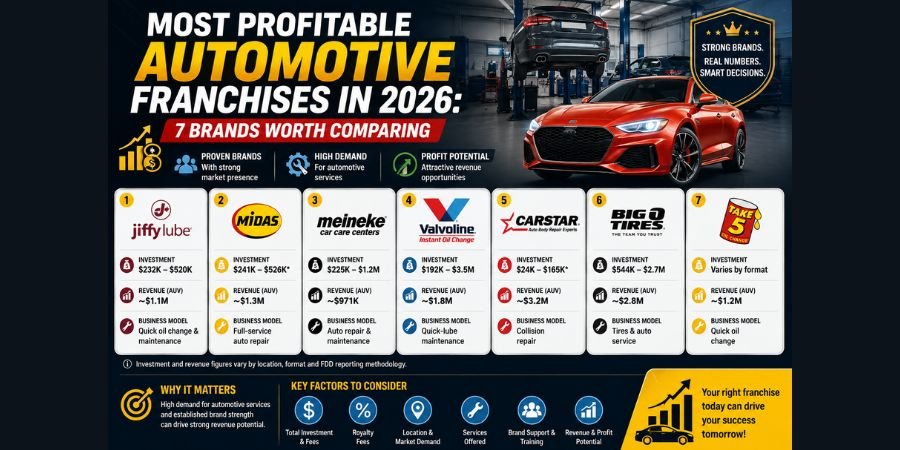
Here is a quick comparison using currently available 2026 FDD and franchise data:
| Franchise | Approx. Investment | Reported Revenue/AUV | Business Model |
| Jiffy Lube | $232K–$520K | ~$1.1M | Quick oil change & maintenance |
| Midas | $241K–$526K* | ~$1.3M | Full-service auto repair |
| Meineke | $225K–$1.2M | ~$971K | Auto repair & maintenance |
| Valvoline Instant Oil Change | $192K–$3.5M | ~$1.8M | Quick-lube maintenance |
| CARSTAR | $24K–$165K* | ~$3.2M | Collision repair |
| Big O Tires | $544K–$2.7M | ~$2.8M | Tires & auto service |
| Take 5 Oil Change | Varies by format | ~$1.2M | Quick oil change |
Investment figures and revenue figures can vary significantly by location, format and FDD reporting methodology.
The numbers make one thing obvious: there is no single “most profitable” automotive franchise for every investor.
Is Jiffy Lube a profitable automotive franchise in 2026?
Jiffy Lube is one of the largest and most established automotive maintenance franchise systems, with more than 2,000 locations and reported median annual revenue of approximately $973,701 in 2026 FDD data.
Its current franchise information lists a 4% royalty, with an initial franchise fee ranging from $17,500 to $35,000, depending on the franchise arrangement.
Jiffy Lube’s model is relatively straightforward: customers come in for routine maintenance, including oil changes, inspections and other services.
That creates an important advantage.
The business does not depend entirely on major mechanical failures. Vehicles require regular maintenance regardless of whether the economy is strong or weak.
Jiffy Lube also says its top-quartile stores generated an average annual revenue of about $1.54 million, based on its 2023 FDD.
For someone looking for an established automotive franchise with a repeat-customer model, Jiffy Lube deserves serious consideration.
Is Midas one of the best auto repair franchises?
Midas is one of the largest established auto repair franchise brands, with reported average revenue of roughly $1.3 million in current comparative franchise data.
The Midas model is broader than a traditional oil-change center.
Its services can include:
- Brake repair
- Exhaust services
- Tires
- Suspension
- Steering
- General maintenance
- Other automotive repairs
Current 2026 FDD-based sources put the investment for a Midas location in the roughly $385,000–$941,000 range, although investment requirements vary by format and location.
The advantage is service breadth.
A customer who arrives for routine maintenance can potentially become a customer for substantially higher-value repair work.
The trade-off is that a full-service repair shop generally requires more equipment, trained technicians and operational management than a basic quick-lube model.
Is Meineke a good automotive franchise investment?
Meineke is an established automotive repair and maintenance franchise with roughly 700 U.S. locations and reported revenue around $970,000 in current franchise comparisons.
Current FDD-based data puts investment at approximately $224,000 to $1.3 million, depending heavily on the business format and property requirements. Its reported royalty is around 7% in current franchise data.
Meineke’s attraction is its broader service mix.
Instead of relying exclusively on one maintenance service, franchisees can generate revenue from multiple categories of automotive repair.
For an investor, that diversification can be useful.
However, higher revenue does not automatically mean higher profit. Rent, technician wages, parts costs, equipment, insurance, royalties and local marketing can materially change the economics of an individual location.
Is Valvoline Instant Oil Change profitable?
Valvoline Instant Oil Change is one of the largest quick-lube franchise systems, with more than 2,000 locations and reported revenue of approximately $1.8 million in current 2026 franchise data.
ClearlyFDD’s 2026 data list an investment range of approximately $192,000 to $3.5 million, reflecting the very different costs associated with development formats and locations. The reported royalty is 6%.
The concept is built around speed and convenience. That is important because customers generally do not want to spend half a day getting an oil change.
For franchise investors, the appeal is the combination of:
- High customer frequency
- Recognised branding
- Standardised operations
- Multiple maintenance services
- Strong demand for routine vehicle care
The wide investment range means prospective owners need to examine the exact format and territory rather than relying on the headline number.
Is CARSTAR one of the most profitable automotive franchises?
CARSTAR stands out for reported revenue per location, with current franchise comparison data showing approximately $3.2 million in average revenue.
But CARSTAR is not an oil-change business.
It operates in collision repair, which is a completely different automotive franchise model.
Current data shows investment requirements of roughly $24,000 to $165,000 in one comparison, although prospective franchisees should verify the current FDD because collision-center costs can vary substantially depending on whether a buyer is converting an existing facility or establishing a new operation.
The headline revenue figure therefore needs context.
A collision repair facility can handle significantly larger individual jobs than a quick-lube center, but it also has different equipment, labor, insurance and facility requirements.
CARSTAR is particularly relevant for investors who already have experience in auto body repair or collision services.
Is Big O Tires a profitable automotive franchise?
Big O Tires combines tire sales with automotive service and reports approximately $2.8 million in revenue in current franchise comparisons.
The 2026 investment range is roughly $544,000 to $2.7 million, according to current FDD-based data.
The business has an important difference from quick-lube franchises: inventory.
A tire business has to carry products that vary by size, vehicle and customer requirement.
That can increase working-capital requirements.
At the same time, tires are a recurring automotive need, and customers who visit for tires can also purchase related maintenance and repair services.
For investors with sufficient capital and a strong local market, Big O Tires can be an attractive automotive franchise investment.
Is Take 5 Oil Change worth investing in?
Take 5 Oil Change is a rapidly expanding quick-lube franchise, but its investment requirement is considerably higher for its modern freestanding format.
Current 2026 franchise data places investment at approximately $912,000 to $2.1 million in one FDD comparison, while another 2026 source reports a higher range depending on format.
The model focuses heavily on convenience and drive-through service. That means the real estate is vital enormously.
A highly visible site with easy vehicle access can be much more valuable than simply finding the cheapest available property.
Take 5 is therefore better suited to an investor who can support a larger initial capital requirement.
What makes an automotive franchise profitable?
The most profitable automotive franchises typically combine recurring customer demand, multiple revenue streams, strong unit economics and an operating model that matches the local market.
Before choosing a franchise, examine:
- Revenue per location: Look at Item 19 of the Franchise Disclosure Document where available. Revenue tells you how much the business generates before expenses.
- Actual owner profitability
Revenue is not profit.
Calculate:
Revenue − labor − parts − rent − royalties − advertising − insurance − utilities − debt service = owner economics
- Initial investment: A $1 million franchise producing $2 million in revenue is not automatically better than a $300,000 franchise producing $900,000. Capital efficiency is important.
- Royalty structure: A 4% royalty and a 10% royalty can produce very different economics over several years. For example, Jiffy Lube currently reports a 4% fixed royalty, while current Midas data shows a substantially higher royalty structure.
- Local demand: The best franchise nationally may be a poor investment in an oversaturated market.
Study:
- Vehicle population
- Average vehicle age
- Household income
- Competitor density
- Traffic patterns
- Commercial fleets
- Local repair demand
What is the best automotive franchise to buy in 2026?
For lower-complexity recurring maintenance, Jiffy Lube is one of the strongest options to investigate. For broader repair services, Midas and Meineke are established choices. For higher-revenue models, Big O Tires and CARSTAR stand out, while Valvoline and Take 5 offer strong quick-lube concepts.
There is no universal winner.
The best automotive franchise in 2026 depends on the investor’s capital, operating experience, location and appetite for complexity.
The most important step is not choosing the brand with the biggest revenue number.
It is opening the latest Franchise Disclosure Document (FDD), studying Item 19 earnings information, calculating the complete investment and operating costs, and then testing those numbers against the specific market.
The automotive aftermarket remains a substantial business. In the U.S., franchised new-vehicle dealerships alone generated more than $164 billion in service and parts sales and completed more than 276 million repair orders in 2025, according to NADA.
That tells you where the opportunity is.
The next question is whether your location, capital and operating model can turn that demand into a profitable franchise.