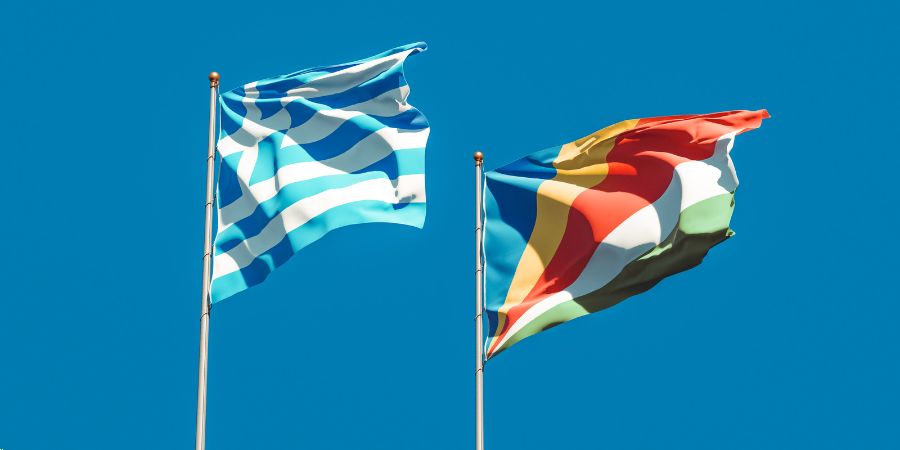
Look at the flags of Argentina, Finland and Greece, and one thing immediately stands out: all three use blue and white, yet their designs could hardly be more different. Argentina has three horizontal bands and a golden sun, Finland uses a blue cross on white, and Greece combines stripes with a cross in the corner. The colours are similar, but the stories behind them are not.
There are 12 countries commonly grouped together because blue and white dominate their national flags: Argentina, El Salvador, Finland, Greece, Guatemala, Honduras, Israel, the Federated States of Micronesia, Nicaragua, San Marino, Somalia and Uruguay. Some also feature other colours in their national emblems.
If you are trying to identify a flag or understand its symbolism, the pattern is often just as useful as the colours. A cross, a cluster of stars or a coat of arms can quickly distinguish one country from another.
Countries With Blue and White Flags: Names and Designs
Below is a quick guide to the countries with blue and white flags and the features that make each design recognizable.
|
Country |
Flag design |
Main significance |
|
Argentina |
Light blue, white and light blue horizontal stripes |
Independence and national identity |
|
El Salvador |
Blue, white and blue horizontal stripes |
Regional geography and Central American heritage |
|
Finland |
Blue Nordic cross on white |
Lakes and winter snow |
|
Greece |
Blue and white stripes with a white cross |
Independence and Orthodox Christian heritage |
|
Guatemala |
Vertical light blue, white and light blue stripes |
Geography, peace and national identity |
|
Honduras |
Blue, white and blue stripes with five stars |
The surrounding seas and historic Central American unity |
|
Israel |
White background, blue stripes and a Star of David |
Jewish identity and religious tradition |
|
Federated States of Micronesia |
Light blue background with four white stars |
The Pacific Ocean and four constituent states |
|
Nicaragua |
Blue, white and blue horizontal stripes |
Geography and regional heritage |
|
San Marino |
White and light blue horizontal bands with a coat of arms |
Liberty and national history |
|
Somalia |
Light blue background with a white star |
National unity |
|
Uruguay |
Blue and white stripes with a golden Sun of May |
Historic departments and independence |
The descriptions above offer a starting point, but colour symbolism is not always straightforward. Some interpretations are officially documented, while others come from historical traditions or popular explanations.
1. Argentina: A Flag Born During the Independence Struggle
Argentina’s flag consists of three horizontal bands, with a white stripe between two light blue ones. The official national flag also carries a golden Sun of May in the centre.
The flag was designed by General Manuel Belgrano and was first flown on 27 February 1812 in what is now Rosario. The colours were officially adopted in 1816 and the Sun was added in 1818. These milestones link the flag to Argentina’s brief history as an independent nation.
Although some describe their meaning as being related to the sky and clouds, the colours of the flag of Argentina can be interpreted in many different ways. And the Sun of May offers a further historical connection.
2. Finland: Blue Lakes and White Snow
Easy to identify even from a distance, the flag of Finland is a white field with a blue Finnish Nordic cross that extends to the edges of the flag and whose vertical part is located to the hoist side.
The colours chosen are symbolic of the natural surroundings. Blue for the lakes and the white for the snow during wintertime. The cross signifies the link to the broader Nordic traditions.
Finland adopted its national flag in 1918, following independence from Russia. Its design is a good example of how a simple arrangement can express both geographical identity and a country’s place within a regional tradition.
3. Greece: Stripes With a Historical Connection
The Greek flag features nine alternating blue and white horizontal stripes. A white cross sits inside a blue square in the upper-left corner.
The cross reflects the importance of Greek Orthodox Christianity in the country’s history. The flag is also associated with Greece’s struggle for independence from Ottoman rule during the nineteenth century.
A popular explanation connects the nine stripes to the syllables of the Greek phrase commonly translated as “Freedom or Death.” However, this interpretation is not universally accepted as the official meaning of the design. The flag’s history is more firmly connected to the country’s independence movement than to any single explanation of its colours or stripes.
4. Israel: The Star of David Takes Centre Stage
The flag features two blue horizontal stripes on a white background with a blue Star of David between the stripes. The flag is based on the tallit, a Jewish prayer shawl.
The flag adopted when Israel became independent in 1948 is highly recognizable thanks to its central star. The blue and white colors on the flag represent the Jewish religion and the identity of the Jewish nation.
Once more, the terrain of the nation is not the crucial point of the design, yet it is rather the religious traditions and historical civic identity.
5. Four Central American Countries with Similar Flags
El Salvador, Honduras, Nicaragua and Guatemala share a flag tradition rooted in the history of Central America. Their similarities are not accidental: the countries emerged from the former Federal Republic of Central America, which existed during the nineteenth century.
El Salvador, Honduras and Nicaragua use horizontal blue-white-blue bands. Guatemala places light blue and white stripes vertically instead. The colours are commonly associated with the Pacific Ocean, the Caribbean Sea and the land between them.
Honduras adds five blue stars to its white band. They represent the five historic Central American states: Costa Rica, El Salvador, Guatemala, Honduras and Nicaragua. Guatemala’s coat of arms features a quetzal, a scroll and crossed weapons, giving its flag a distinctive appearance.
These flags are particularly interesting when studied together. Their shared colours tell part of a regional story, while their different symbols show how each country developed its own national identity.
6. Somalia and Micronesia: Two Flags, Two Different Stories
Somalia’s flag has a light blue background with a white five-pointed star at its centre. First raised in 1954, the flag predates the country’s independence in 1960. Its blue field was influenced by the United Nations flag, and the white star is associated with unity among Somali peoples.
The Federated States of Micronesia uses a similar combination of colours but a different arrangement. Its light blue background represents the Pacific Ocean, while four white stars stand for its constituent states: Yap, Chuuk, Pohnpei and Kosrae.
The contrast between these flags is useful when identifying them. Somalia has one central star; Micronesia has four. That small detail makes the difference immediately apparent.
7. Uruguay: Blue and White With a Golden Sun
Uruguay’s flag contains nine alternating blue and white horizontal stripes. A golden Sun of May appears in the upper-left corner.
The stripes represent the country’s nine original departments, while the sun is associated with the independence movements of the region and the May Revolution. Uruguay’s flag therefore combines a reference to its administrative history with a symbol shared with Argentina.
Although it is regularly included in lists of blue and white flags, Uruguay’s design also features gold. This illustrates why such lists can vary according to whether they classify flags by their dominant colours or require them to contain only two colours.
8. San Marino: A Coat of Arms Against Two Simple Bands
San Marino’s flag is divided into white and light blue horizontal halves. Its coat of arms, featuring three towers on Mount Titano, appears in the centre.
The colours are associated with peace and liberty, while the towers refer to the republic’s historic landmarks and identity. The combination of a simple background and a detailed emblem gives the flag a character quite different from those made up entirely of stripes or stars.
San Marino’s design also shows why examining the full flag matters. Two flags may share the same colours but communicate very different histories through their central symbols.
What Do Blue and White Flags Have in Common?
There is no universal rule that explains the meaning of blue and white on every national flag. Blue often refers to the sky, lakes or surrounding seas, while white may represent snow, peace or national ideals. In other cases, the colours have become meaningful through religious traditions, independence movements or shared political histories.
The arrangement matters, too. Finland’s cross reflects the Nordic design tradition; Micronesia’s four stars represent its states; and Honduras uses five stars to recall a former regional federation. Looking only at colour can therefore miss some of the most important information a flag carries.
Conclusion
The countries with blue and white flags offer more than a collection of similar-looking national symbols. Argentina’s sun, Finland’s cross, Israel’s Star of David and Micronesia’s four stars each tell a different story.
When identifying a flag, start with its dominant colours, then look at the arrangement of its stripes and any symbols it contains. That simple approach makes it easier to distinguish similar designs and understand why countries chose to represent themselves in different ways.
5 Takeaways from the Author
- Twelve countries commonly feature in blue-and-white flag lists, but the total depends on how the colours are classified.
- Flag patterns help identify countries: crosses, stars, stripes and coats of arms provide useful visual clues.
- Blue often reflects geography, including oceans, lakes and the sky, although its meaning differs across national traditions.
- Four Central American countries share a historical connection through the former Federal Republic of Central America.
- Colour symbolism is country-specific. A flag’s history and official descriptions provide a stronger basis for interpretation than assuming every colour has the same meaning everywhere.